
Energy Dominance
In 2023, American data centers alone consumed an estimated 176 terawatt-hours of electricity—4.4 percent of the nation’s total. By 2028, that demand is projected to reach up to 580 terawatt-hours, an increase of roughly 230 percent, accounting for as much as 12 percent of U.S. electricity consumption.
Yet data centers are only part of the story. EIA forecasts total U.S. electricity generation will grow another 2.2 percent this year, reaching a record high. Meeting this demand requires a coordinated strategy for energy dominance—one that enables America to permit, finance, and build the infrastructure that powers its economy.
This study guide, created in partnership with the American Conservation Coalition, is intended to give junior and mid-level staffers and policymakers a starting point with which to explore what an America First energy policy requires, how abundant energy supports prosperity and national security, and what the United States must do to turn energy dominance into projects that actually get built.
What You’ll Learn
Energy is the foundation for everything in a prosperous society, powering our food production, our transportation, our hospitals and schools, and our military strength. An energy dominance agenda aims to make that energy abundant, reliable, and affordable, strengthen American industry and our allies, and innovate the technologies of the future.
But ambition alone doesn’t generate electricity. Projects need permission to proceed, financing to get built, and technologies ready for commercial use. This guide makes the case for three complementary priorities: permitting reform, capital deployment, and innovation. Skilled workers turn all three into operating infrastructure and the middle-class jobs that reindustrialization promises.
Drawing on research from American Affairs, the Foundation for American Innovation’s Techno-Industrial Policy Playbook, C3 Solutions, and ClearPath, along with the White House’s National Security Strategy and conversations with energy executives and federal financing officials, this guide examines how America’s energy system works, what stands in the way of new infrastructure, and how policy can speed its deployment.
By the end of this Study Guide, you’ll be able to answer the following:
- What prevents energy infrastructure from getting built?
- How should permitting reform balance national priorities, environmental protections, and state and local authority?
- How can federal lending, public investment, and export finance draw in private capital while protecting taxpayers and keeping energy affordable?
- What will it take to bring advanced nuclear, next-generation geothermal, and other emerging technologies to market, and to train the workers who build them?
- How should an America First energy agenda weigh competing technologies and interests, and how will we know if it delivers affordable power, stronger supply chains, and good jobs?
Part I: Primer
For over two decades, American energy demand was essentially flat, so abundance was not an issue. That era is over. For the first time in a generation, energy demand is growing at an unprecedented rate, largely driven by the buildout of new critical infrastructure like data centers for artificial intelligence, factories for advanced manufacturing, and electrification of transportation, buildings, and industry.
Our energy infrastructure, as it is currently built, is outdated, fragmented, and straining to keep up. If we continue under the status quo, we will become a country of energy scarcity, not abundance. For America, from the family budget to our national security, that is unacceptable.
How the system works. “Energy” covers two buckets: the fuels we produce (e.g., oil, natural gas, coal, and uranium) and the electricity we generate from them and from wind, solar, hydro, and geothermal.
Electricity moves in three stages: electricity generation at a power plant, high-voltage transmission to move those electrons over long distances, and local distribution to deliver those electrons to consumers.
Because supply and demand on the grid must balance in real time, not all power is the same. Dispatchable sources like nuclear, natural gas, and hydro run on command; variable sources like wind and solar depend on the weather. Wind and solar are a growing, low-cost part of the American energy mix, but until storage technologies reach grid scale, they cannot meet the around-the-clock demand on their own. That is why “clean firm” power, mainly nuclear and geothermal, is the gold standard: always available and low-emission.
One last distinction: power is the rate electricity is delivered, measured in watts (kilowatts, gigawatts), while energy is the total delivered over time, measured in watt-hours.


Energy Framework for the Common Good
by Chris Barnard & Isaiah Menning
Summary Chris Barnard and Isaiah Menning explain why all-of-the-above energy addition should be and is a core feature of a politics that supports human flourishing.
- Dive Deeper The main barrier to energy dominance is federal obstruction, whether implicit, through outdated permitting systems, or explicit, through the executive lawfare that both political parties have wielded against technologies they dislike.
- The Solution In order to properly achieve energy dominance, American energy policies should first return to a federalist approach, deferring to state and local governments, and providing support through the following three pillars: (1) permitting reform, (2) capital deployment, and (3) innovation.
Why Read This essay offers a logical overview of the contents of this study guide and tackles the “common good” thesis, the “why” Energy Dominance is so critical to human flourishing.
Study Question Barnard and Menning say energy addition is in service to the common good, but they also argue that infrastructure siting and landscape aesthetics should be decisions left up to states and local communities. They then carve out exceptions for interstate projects of national importance. That line is fuzzy. When is something “national” enough to override local choice? Who gets to decide what the common good requires?
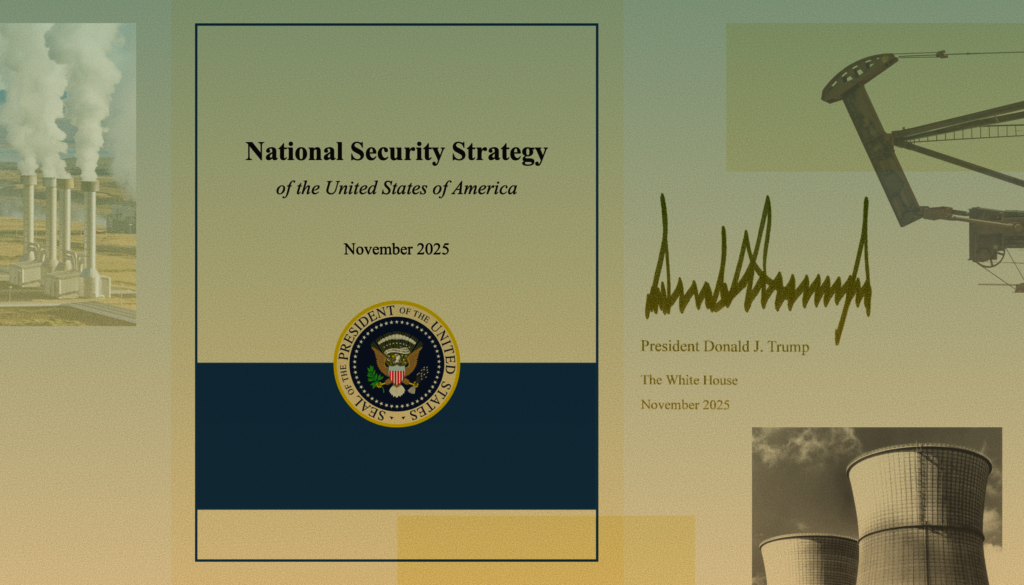

2025 National Security Strategy
by the Trump Administration
Summary The Trump administration outlines the U.S. government’s national security strategy. Among other things, the administration identifies restoring energy dominance as a key strategic priority for ensuring our economic security, with the latter being fundamental to our national security.
Why Read This is the sole document in this study guide that establishes energy as a geopolitical and great-power question rather than a domestic-policy one. Focus on pages 13 and 14 to grasp how energy dominance fits into our national security imperatives. Cheap and abundant energy creates well-paying jobs, reduces costs for American consumers and businesses, fuels reindustrialization, and wins the AI race. Expanding energy exports strengthens our alliances and weakens our adversaries.
Study Question The Trump administration frames energy dominance as a national security imperative, casting LNG exports as a tool of statecraft for both alliance-building and coercive leverage. How does that reorient your understanding of energy infrastructure beyond just economic or environmental imperatives?

with Toby Rice
Summary In this interview, Chris Barnard (American Conservation Coalition) speaks with Toby Rice, CEO of natural gas producer EQT, about American energy exports. Rice opens with a five-part framework for energy dominance:
- protecting America’s low-cost energy advantage,
- winning the AI race,
- providing energy security to allies,
- displacing hostile petrostates with American influence, and
- ending global energy poverty.
Most of the conversation makes the case for U.S. LNG. Because American gas is produced more cleanly than the coal it displaces abroad, Rice argues that expanding exports is at once a national-security, economic, and environmental win.
Why Watch Rice provides an excellent articulation of what energy dominance actually means, including why abundant, exportable energy, and U.S. LNG in particular, is the foundation under everything else.
Study Question Rice argues that energy dominance means exporting aggressively, to secure allies, counter adversaries, and end energy poverty, while keeping energy cheap at home. Those goals can pull against each other. How should energy dominance weigh maximizing exports against affordability for American families?
Part II: Permitting Reform
The fastest way to get more energy in America is broad-based permission to build. America produces more energy than ever before—yet aging infrastructure prevents us from turning that production into power delivered to where it’s needed. A power plant, a pipeline, or a transmission line can clear every technical and economic hurdle and still sit unbuilt for a decade, tied up in environmental review and litigation.
At the center of federal permitting is the National Environmental Policy Act (NEPA), which requires federal agencies to study the environmental effects of major projects before approving them. The Clean Water Act, the Endangered Species Act, the Clean Air Act, and the National Historic Preservation Act each add their own reviews, each run by different agencies. In principle, these are reasonable safeguards, but in practice, reviews drag on for years, and because each step can be challenged in court, a few NGOs can delay or kill a project through litigation alone.
No other type of infrastructure is hit harder than transmission. Meeting the coming surge in demand will require a major buildout of new high-voltage lines, but a single line can cross many counties, states, and waterways, triggering every statute and giving every jurisdiction a chance to block it.
Note: As of October 2026, permitting reform is an active issue before Congress, as the Senate has released the legislative text for the Bipartisan American Affordability and Jobs Act, a 400+ page bill which would address many of the issues covered in this section.
by Pavan Venkatakrishnan
Summary In this essay, Pavan Venkatakrishnan argues that U.S. energy policy has shifted from enabling the buildout of energy infrastructure to obstructing it through litigation, regulation, and politics. The intended targets of this obstruction and its impacts vary depending on one’s political coalition and preferred technologies, but America as a whole bears the brunt and suffers.
Key Point If we are to claim supremacy in the 21st century in the face of our adversaries, we must adopt a governing principle of “energy addition,” in which infrastructure buildout is seen as a net societal gain.
Why Read Venkatakrishnan provides the conceptual and philosophical frame of “energy addition,” that energy infrastructure should be permitted by default.
Key Quote “Most energy infrastructure developed in competitive markets should be treated as prima facie permissible. Projects should not have to run through an obstacle course of suspicion before they can earn the right to exist.“


by Thomas Hochman
Summary Thomas Hochman argues that NEPA has drifted from an environmental-review statute into one of the most effective tools for obstructing the buildout of energy infrastructure, through decades of expanding scope and litigation.
- The second Trump administration’s decision to strip the Council on Environmental Quality of its regulatory authority opened a path to fix this administratively, without waiting on Congress.
- Hochman lays out three reforms that agencies can pursue under existing law: (1) narrowing what counts as a “major Federal action,” (2) expanding categorical exclusions, and (3) narrowing what triggers a full environmental impact statement.
Why Read This piece shows how permitting reform actually gets done and provides us with a model of what it could look like in practice.
Study Question Since publication, much of what Hochman proposes here has been enacted through agency action rather than legislative statute. Is that administrative route a durable foundation for permitting reform, or a fragile one that a future administration could reverse and that opponents can challenge in court?
by Nick Loris
Summary Nick Loris walks through several permitting barriers to project development and their respective policy reforms. He explains how a maze of overlapping statutes lets a handful of litigants stall or kill projects (Keystone XL, the Atlantic Coast Pipeline, a New England transmission line held up for years), and lays out what a comprehensive bill should fix across five laws.
Why Read Loris asks what a durable permitting statute should actually contain, across the five environmental laws, not just NEPA.
Study Question Loris wants a strengthened federal FERC backstop for transmission siting while keeping states in the lead. Where should the line sit between federal and state power so that nationally important lines actually get built, without simply overriding the local and state choices this guide defends elsewhere?
Part III: Capital Deployment
Energy infrastructure projects are some of the hardest things to finance; closing that financing gap is what enables the buildout to go from plans on paper to steel in the ground.
Power plants, transmission lines, and first-of-a-kind technologies are massive and capital-intensive, with enormous upfront costs. A single new reactor (an AP1000) runs on the order of $10+ billion, and novel first-of-a-kind technologies like advanced nuclear and next-generation geothermal have the added risk of costs ballooning before the design is even finalized and approved by regulators. Most private lenders avoid investing in projects with these risk profiles.
The core problem is a gap between two numbers. A firm’s hurdle rate, i.e., the return on investment necessary to greenlight a project, is typically inflated well above the firm’s cost-of-capital, i.e., what it costs to raise money. Projects that would comfortably clear the cost of capital, and would contribute to the country’s prosperity, still go unbuilt because they fall short of meeting that hurdle rate. Public financing seeks to close that gap, funding solid projects that are too “risky” for the private market to stomach.
with Julie Kozeracki
Summary Julie Kozeracki, Acting Chief Investment Officer of the Department of Energy’s Office of Energy Dominance Financing (EDF), explains what the office is and how it works. EDF is a senior lender with over $300 billion in authority across three programs, financing high-impact energy projects that private capital won’t underwrite alone, at long tenors and competitive rates, with interest savings passed through to ratepayers.
Why Watch This interview offers a real-world example of an existing financing vehicle. That contrasts with the following piece by Julius Krein, who argues for a public financing vehicle that doesn’t yet exist.
Study Question Kozeracki argues that cheap nuclear depends on repeat-building a single design, so that no utility has to eat the cost of being “first.” Yet the U.S. built its 94 reactors across more than 50 designs and never moved down that learning curve. What can a federal lender like EDF actually do to break that pattern, and why might its financing organize a standardized build where the private market hasn’t?

New Incentives for Critical Industries
by Julius Krein
Summary Julius Krein argues that America cannot rebuild its industrial base without changing how it finances capital-intensive industry. His core claim is that firms maximize shareholder value rather than profit, so they hold out for returns above their cost of capital and favor financial engineering over real investment. This starves critical sectors of capital that tax cuts and deregulation cannot supply. Krein’s solution is a development-oriented U.S. sovereign wealth fund, modeled on Vance’s IFCUS proposal, that uses public capital to crowd in private investment.
Why Read This piece explains why private markets underinvest in critical industry and why public capital can be corrective rather than necessarily a market distortion.
Study Question Since he wrote this, the Trump administration has taken ad hoc equity stakes in firms like Intel and MP Materials, with none of the structure or returns mandates that Krein called for. Does that strengthen his case for a properly designed investment vehicle, or vindicate critics who warn that public investment becomes politically directed winner-picking?
by Justin Williams
Summary Justin Williams argues that the Export-Import Bank (EXIM) is an underused instrument of energy dominance, and that Congress should reauthorize and modernize it in 2026. EXIM finances U.S. energy exports and, through its Make More in America Initiative (MMIA), the domestic manufacturing that private lenders won’t underwrite alone. Williams proposes reforms, chiefly a National Interest Account for strategic projects and easing EXIM’s unusually strict 2% default-rate cap, so American producers can match aggressive foreign export-credit agencies and hold their place in global supply chains.
Why Read Trade and supply-chain security are instruments of statecraft. EXIM is the tool for competing abroad, using export finance and support for domestic manufacturing to pull supply chains toward the U.S. and deny China control of the global energy market.
Study Question Williams frames EXIM as a tool for winning export markets abroad. In the months since, the administration turned EXIM inward with Project Vault, a record $10 billion loan to build domestic critical mineral reserves and cut dependence on China. As EXIM takes on this expanded role in securing supply chains, what reforms to its mandate and guardrails would let it do that effectively without crowding out the private capital it should be attracting?
Part IV: Innovation
Winning the 21st century requires not just building more of what we already know but also inventing what comes next, and building it here in America.
The energy technologies that will define the next era, including advanced nuclear (including fusion), next-generation geothermal, battery storage, and other emerging technologies, go through a long innovation pipeline: basic research, applied R&D, demonstration, and finally commercial deployment. Each stage costs more than the last, and the government’s national labs, the world’s largest engine of applied scientific research, have long anchored the earliest stages. The shale revolution proves the model: decades of public-private research that industry brought to market, making America a global energy superpower.
The hardest stretch is the “valley of death,” where a promising technology proven in a lab gets stranded before reaching full-scale commercial deployment. Crossing that valley of death is partly a financing problem and partly a question of whether the government structures its R&D programs to push technologies to deployment rather than stopping at basic science.
If the national labs can push technologies to the doorstep of commercialization, tax credits are a powerful tool to carry them across that threshold. The investment and production tax credits (the ITC and PTC) lower the cost of building and running first-of-a-kind projects like advanced nuclear and next-generation geothermal, improving the economics enough that private capital will finance a plant that would otherwise pencil out as too risky.
Underlying all of these factors is one input: people. The most advanced reactor design is worthless without the skilled workers to build and operate it. Reindustrialization is, in the end, a promise of those jobs. Workforce is the binding constraint on permitting, capital, and innovation alike.
by Jeremy Harrell
Summary Jeremy Harrell writes that surging demand from AI, data centers, and manufacturing has ended the era of flat energy growth, and that the U.S. must lead by commercializing the next generation of energy technologies through the Department of Energy and its seventeen National Labs. His model is the shale revolution: decades of early-stage federal R&D de-risked unconventional gas until private industry could commercialize it, eventually making the U.S. the world’s top oil and gas producer.
Key Point The problem, he argues, is that DOE’s Cold War-era structure pushes officials to champion favored technologies rather than focus on outcomes and deployment. He calls for the next administration to reorganize the applied energy offices around an integrated, technology-neutral, deployment-first mission.
Why Read Harrell’s shale revolution model is the template: public-private partnership that produces breakthroughs and scales them at home. Written as a to-do list for the next administration, it now serves as a benchmark for what the second Trump administration actually did.
Key Quote “As far as shale is concerned, I don’t know that industry would have ever taken a look at it without the federal program.“
Study Question Harrell’s diagnosis, that DOE’s structure pushes officials to back favored technologies, became official policy during this presidency. Is a technology-neutral innovation agency achievable, or does energy dominance in practice mean picking winners?

by Chris Griswold
Summary Chris Griswold argues that a shortage of skilled workers is a serious obstacle to reindustrialization and a source of national vulnerability, and that federal policy makes it worse by funneling most education dollars into a higher-education system disconnected from what employers and good middle-class jobs actually require. He proposes a $10,000-per-trainee annual grant, administered by the Department of Labor, to make high-quality on-the-job training viable for employers and workers, paid for by an expanded university endowment tax and by rebalancing existing education spending.
Key Point Griswold identifies an inherent market failure: employers underinvest in training because an upskilled worker can demand more pay or leave to a competitor, leaving the employer holding the cost of training someone else’s hire.
Why Read Griswold’s proposals have moved fast since publication. The bill he mentions was reintroduced as the American Workforce Act in October 2025, and the OBBBA both raised the university endowment tax and created Workforce Pell for short-term job training.
Study Question If the U.S. reshores manufacturing and energy at the scale that this study guide envisions, the workers to build it may be the binding constraint deciding whether any of it actually happens. Should the federal government fund that training directly, or does Griswold’s own argument, that employers understand the needed skills best, point toward leaving it to employers and states?
Energy is the foundation of American prosperity and power; the country that produces it in abundance will dictate the terms of this century. Securing that energy abundance is not a single policy but rather a trio of complementary priorities. Permitting lets us build, capital lets us finance what we build, and innovation lets us build what comes next. Move on only one and the other two constrain it: a permitted project still needs financing, a financed project still needs technology that works, and a breakthrough still needs a clear path to get built.
One input underpins all three. Permitting clears the project, capital funds it, and innovation designs it, but none of it reshores a single job without the skilled workers to do the work. Workforce is the binding constraint on the whole agenda, and it is also the point: reindustrialization is, in the end, a promise of good middle-class jobs, stronger domestic supply chains, and communities rebuilt around them.
If we can get energy dominance right, the payoff runs through the entire economy, from the family energy bill to national security, with cleaner air and conserved landscapes as real co-benefits.
Further Study
Reindustrialization Requires Energy Dominance | The Bully Pulpit
- Quick Take Daniel Bring (American Affairs) argues that reindustrialization and energy dominance are one project. Factories run mostly on natural gas and petroleum rather than grid power, and it was the 1970s oil shocks, not cheaper foreign labor, that broke American heavy industry. Read it for the manufacturing case for all-of-the-above energy and for three priorities that track this guide: permitting reform, treating the energy industrial base as strategic, and domestic energy R&D.
Podcast: America’s New Atomic Age (ft. Isaiah Taylor)
- Quick Take Isaiah Taylor, founder of Valar Atomics, explains how four Trump executive orders took his company from a pitch deck to the first startup nuclear criticality in American history in under three years. Listen for a builder’s view of how regulatory reform turns into real reactors, and why cheap energy decides the competition with China.
A Conservative Vision for Abundance | American Affairs Journal
- Quick Take Chris Barnard (American Conservation Coalition) answers Klein and Thompson’s Abundance with a conservative alternative: build more, but in service of family, public virtue, and stewardship of nature, with states in the lead. Barnard shows that NEPA litigation delays energy and forest projects by years even though agencies win over 70 percent of appellate cases, and he proposes charging fees on fast-tracked energy and AI projects on federal land to fund conservation.
A New Energy-security Paradigm | National Affairs
- Quick Take Chris Barnard (American Conservation Coalition) uses Europe’s energy crisis to argue that America must keep oil and gas dominant today while beating China on the clean-energy technologies and supply chains of tomorrow. Read it for the geopolitical case behind this guide’s all-of-the-above approach.


